
Most writing about affiliate marketing comes from networks trying to recruit you or platforms selling software. The basics get buried under hype. We wanted a plain version: what it is, why companies use it, and which sectors in Canada lean on it hardest.
What Affiliate Marketing Is
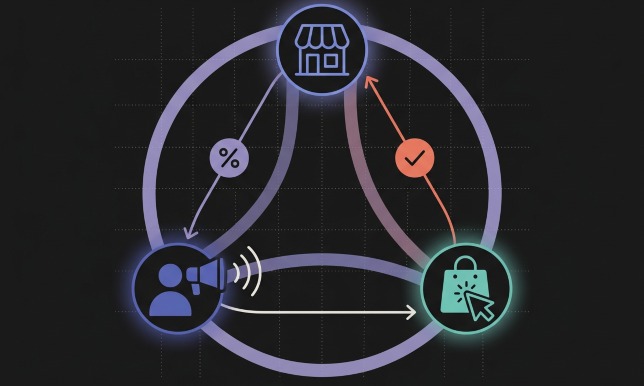
Affiliate marketing is performance-based advertising. A company pays a third party, an affiliate, for driving a specific action. That action might be a sale, a sign-up, or a lead. Affiliates use their own channels: websites, social media, email lists, or paid traffic. They get paid when something happens.
It’s not charity. It’s a math problem. Companies pay affiliates because affiliates can acquire customers cheaper than the company can do itself. According to 2026 benchmarks, affiliate customer acquisition cost is 62% lower than paid search on average.
In the U.S. and Canada, affiliate programs account for about 16% of all e-commerce orders. That’s on par with email marketing.
Why Companies Use Affiliate Programs
Three reasons.
First, cost control. You only pay when something happens. No upfront media spend. No guessing if the ad worked. If an affiliate doesn’t perform, you don’t pay. It’s the closest thing marketing has to a no-risk model.
Second, scale. A single company cannot hire enough marketers to cover every niche, every audience, every channel. Affiliates are distributed. They bring their own audiences, their own content, their own traffic. You tap into hundreds or thousands of promoters without hiring any of them.
Third, ROI. The math holds. For every $1 spent on affiliate marketing, brands receive an average of $6.50 in return, according to 2026 data. Other sources put the return rate at 15:1. Either way, it works.
Globally, the affiliate marketing industry generated $19.6 billion in 2025 and is projected to reach $24.7 billion in 2026, a 26% year-over-year increase. Growth rates sit at 8% to 15% annually, driven by the rise in online shopping and smarter tools like AI.
Industries That Rely on Affiliates
Not every industry uses affiliates equally. Here are the ones that lean in hardest.
SaaS (Software as a Service)

SaaS companies love affiliates because the math works long-term. A customer acquired through an affiliate stays for months or years. That makes recurring commissions valuable – a $10/month recurring commission compounds to $360 over three years, while a $50 one-time commission stays $50.
SaaS affiliate programs offer the highest commission rates in the game – 20% to 40% recurring. Median SaaS commission across major networks sits at 22.5% of first-year revenue.
Canadian SaaS companies are active here. Freshbooks pays up to $200 per qualified sale. ConvertKit pays 30% recurring on their email platform. QuickBooks Online runs its own business affiliate program. More than half of SaaS affiliate programs operate with fewer than 50 affiliates, and nearly one-third have fewer than 10, which means the space is still relatively open for new entrants.
SaaS affiliate programs are forecasted to grow at a 15.6% annual rate through 2028.
Finance
Financial services are a natural fit for affiliates. The products are high-ticket (credit cards, mortgages, insurance, investment accounts), so commissions are substantial. Financial services or insurance can pay $200 to $500 per conversion.
Canada has its own financial affiliate ecosystem. Neo Financial grew net new customers by 511% through affiliate marketing. In their first month working with Fintel Connect, they saw a 400% increase in high-quality partnerships.
The Financial Affiliate Marketing Forum (FAMF) 2026 takes place in Toronto on October 6, 2026, billed as Canada’s premier gathering for financial affiliate marketing. The 2025/2026 Financial Industry Affiliate Marketing Report surveyed over 100 affiliates actively working with banks, credit unions, and fintechs across the U.S. and Canada.
57% of marketers are increasing their investments in affiliate marketing. Financial brands that delay exploring affiliate partnerships risk being left behind as competition intensifies.
KOHO, a Canadian fintech, is actively hiring affiliate marketing roles to drive growth across its affiliate channel.
Online Casinos

Online casinos and iGaming are among the heaviest users of affiliate marketing in Canada. The reason is simple: paid advertising is restricted. Google Ads, Meta, and other platforms have tight rules around gambling promotions. So, operators turn to affiliates (review sites, comparison portals, streamers, and SEO publishers) to drive player acquisition.
Affiliates drive 40% to 60% of new depositing players for most iGaming operators. That’s not a side channel. That’s the main channel.
Canada’s online gambling market has over 19 million active gamblers, with average revenue per user in the online casino and betting sectors sitting at $220.
Affiliate deals in the casino space usually follow one of three models:
- Revenue share: 20% to 40% of the player’s losses or net revenue
- CPA (Cost Per Acquisition): C$200 to C$3,000+ per depositing player
- Hybrid: A smaller CPA plus a long-term revenue share
The landscape is maturing. In 2026, operators pay closer attention to player retention, deposit activity, and long-term value instead of focusing only on sign-up volume. Pure acquisition isn’t enough anymore.
Ontario is the regulated benchmark. iGaming Ontario (iGO) has created a structured, regulated market. Alberta represents a newly regulated opportunity, but as Andrew Garven, Head of Affiliate Marketing at BET99, puts it: “While there may be regulatory similarities, your Alberta playbook in 2026 cannot mirror Ontario’s. Market maturity matters.”
The AGCO fined an operator CAD $110,000 in 2025 for violations committed by a contracted affiliate, specifically, offers of cash inducements to open wagering accounts. That fine signals that regulators are watching affiliates, not just operators.
How Online Casino Affiliate Partnerships Work
Online casino affiliate partnerships follow a distinct pattern.
Step one: the affiliate builds an audience. This usually happens through content: casino reviews, game guides, bonus comparisons, or streaming. SEO is the primary driver. Affiliates target terms like “best online casino Canada” or “Ontario casino bonuses.” The content needs to be credible because players are wary of scams.
Step two: the affiliate sends traffic to the operator. This happens through tracked links. The operator’s affiliate platform assigns a unique ID to each affiliate. Every click, registration, and deposit gets attributed.
Step three: the operator pays. Payment models vary. Revenue share is common: the affiliate gets a percentage of the player’s net revenue (losses minus bonuses and fees) for the lifetime of the player. CPA pays a flat fee per depositing player. Hybrid combines both.
The commission structures can be aggressive. Some programs offer 20% to 40% revenue share for the lifetime of the player. That means a single high-value player can generate thousands of dollars in affiliate commissions over several years.
What affiliates look for in a casino partner:
- Canadian payment support (Interac e-Transfer, Interac Online)
- CAD pricing and transparent cashier
- Clear licensing (AGCO/iGaming Ontario or clarity for the rest of Canada)
- Positive player reviews on withdrawal speed
The future, according to industry insiders, is a shift from pure acquisition to full-funnel audience ownership. Affiliates are no longer just traffic sources. They’re building owned audiences that operators can’t replicate.
Risks and Compliance Considerations
Affiliate marketing in Canada isn’t unregulated. There are real rules, and breaking them costs money.
Disclosure. You must disclose affiliate relationships. Ad Standards updated its guidelines in October 2025, a simple “I may earn commissions” covers it.
CASL. Email marketing requires valid consent and three years of records. No exceptions.
Taxes. The CRA expects you to report all affiliate income (commissions, sponsorships, free products). No minimum threshold. Even $500 counts.
Gambling. Casino affiliates face extra scrutiny. The AGCO bans cash inducements to open accounts. They fined an operator $110,000 in 2025 for violations by an affiliate. Know the rules in each province.
Ad platforms. Google and Meta restrict gambling promotions. Violations can get your accounts banned. Stay current.
Disclaimer
This website is not affiliated with GrowthKings or any of its services. This is an independent digital marketing resource.
We gathered this information from publicly available sources in June 2026. Details about the companies and platforms mentioned, along with prices and market figures, can change over time, so please verify them directly before making a decision. Nothing here is a recommendation, an endorsement, or a guarantee of any result.