
If you sell online in Canada and you have started shopping for help, the phrase e-commerce marketing services covers a lot of ground. It can mean running Google Shopping ads one week and rebuilding your email flows or managing an Amazon storefront the next. We wrote this to make the category clear: what these services are, what they cost here in 2026, and how to pick a provider without the usual hard sell.
The figures below come from public sources we checked, including Statistics Canada and industry directories.
In numbers
$4.0B
Canadian online retail sales per month, as of November 2025
6%
of retail is online by the official survey, closer to 13% on broader measures
21M+
Canadians shop online
68%
say they actively look for Canadian products
Sources: Statistics Canada (November 2025 release) and eMarketer.
The Canadian E-commerce Market in 2026
First, some honest context, because two very different numbers get quoted. By the official retailer survey from Statistics Canada, online sales were about 4.0 billion dollars in November 2025, which is roughly 6 percent of all retail trade. Broader estimates from firms like eMarketer put it closer to 13 percent, because they also count marketplace volume, travel, and digital subscriptions that the retail survey leaves out. Both are right for what they measure. For sizing your own store’s opportunity, the official figure near 6 percent is the safer one to plan around.
The other useful fact is that growth has levelled off. After the pandemic surge, the online share of retail has sat in a narrow band of about 6 percent through 2025 rather than climbing. So, in Canada, the game is less about riding a rising tide and more about taking share from competitors, which is exactly what good marketing does. The upside is a large and ready audience. More than 21 million Canadians shop online, and a clear majority say they actively look for Canadian products, which is worth leaning into if you are a domestic brand.

What E-commerce Marketing Services Include
Most providers offer some mix of the channels below. A good one will tell you which two or three matter for your store right now, instead of selling you all of them at once.
Service | What it does | Best for |
|---|---|---|
E-commerce SEO | Gets your category and product pages found on Google and AI search | Cheaper traffic that builds over time |
Paid search & Shopping | Puts your products at the top of buying searches | Quick sales when margins allow |
Paid social (Meta, TikTok) | Creates demand and retargets shoppers who left | Finding new customers |
Email & SMS | Automated flows for carts, welcomes, and repeat orders | Low cost revenue from existing buyers |
Marketplace (Amazon, Walmart) | Runs and optimizes your listings and ads | Brands selling on big marketplaces |
Conversion optimization | Improves product pages and checkout to lift sales | Stores with traffic but weak sales |
What These Services Cost in Canada
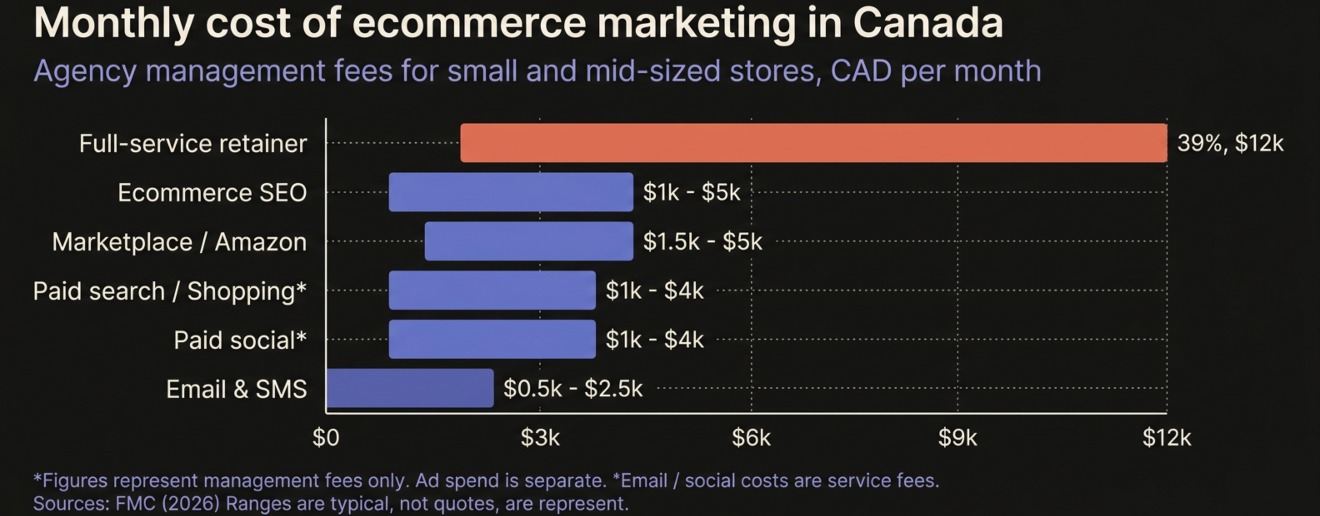
Pricing is rarely posted, but the patterns are clear. For small and mid-sized stores, monthly retainers for ecommerce work commonly run from about $2,000 to $12,000, depending on how many channels you cover. Single channels sit lower. Managed SEO often starts near $1,000 a month, email programs from a few hundred, and ad management fees from around $1,000. Hourly help runs from about $75 to $150 for freelancers, and up to $200 or more at senior agencies in Toronto and Vancouver.
Two things to keep straight. With paid ads, the management fee is separate from the ad spend itself, which you almost always pay to Google or Meta directly with your own card. And many e-commerce brands plan to reinvest roughly 10 to 11% of revenue into marketing, which is a more useful yardstick than any flat fee. On terms, a three-month starter period is fair, a thirty-day notice is normal, and a ninety-day lock in is a reason to push back.
Who Offers These Services Today
Providers tend to fall into a few camps. Full-service agencies cover most channels under one roof. Ecommerce specialists focus on online stores and often live in the Shopify world, which makes sense given Shopify is a Canadian company. Marketplace specialists do little besides Amazon and Walmart, and they earn their keep when that is most of your revenue.
You will find all three in neutral directories such as Clutch and Semrush, where you can filter by Canadian location and read verified client reviews. We are not naming a single best one here, because the right fit depends on your platform, your category, and your budget.
How to Choose
Before you sign anything, we would work through these.
- Ask for results from stores like yours, ideally on the same platform and with a similar order value. A wall of logos is not proof.
- Make sure your tracking works first. Without clean GA4 and reliable conversion data, no one can prove what is working.
- Confirm you own your store, ad accounts, email list, and analytics, and that you keep them if you leave.
- Get the monthly deliverables and the reporting schedule in writing.
- Treat any promise of a fixed sales figure or a number one ranking as a reason to ask harder questions.
Disclaimer
This website is not affiliated with GrowthKings or any of its services. This is an independent digital marketing resource.
We gathered this information from publicly available sources in June 2026. Details about the companies and platforms mentioned, along with prices and market figures, can change over time, so please verify them directly before making a decision. Nothing here is a recommendation, an endorsement, or a guarantee of any result.